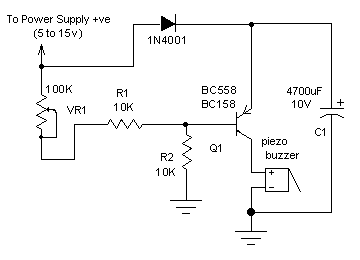
Circuit diagram for power failure alarm This circuit will warn you the moment there's a power failure or an interruption in the mains. In some specific situations it might be crucial to understand whether the mains that powers some appropriate system or circuit is missing. How the power failure alarm functions This suggested circuit is hooked up to the power mains via the transformer T1.

As soon as the mains power fails, the charge stored in the capacitor acts as a power-supply source for transistor T1. Since, in the absence of mains supply, the base of transistor is pulled 'low' via resistor R8, it conducts and sounds the buzzer (alarm) to give a warning of the power-failure. Power Supply Failure Alarm Circuit

Power Interruption Alarm Circuit for Instant Power Failure Indications Circuit Diagram
A DIY Main Power Supply Failure Indicator Circuit designed by using few easily available components, Ensuring the reliability of power supplies is crucial in various electronic applications, ranging from consumer electronics to industrial systems. This simple circuit can help us to take appropriate action in case of power interrupt or failure.

A very simple 12V power supply failure alarm circuit. Low voltage, no stand-by current, piezo alarm. The working of this power failure alarm circuit is very simple. A power Supply of 220 volts is turned on. This 220 volt is converted into 12 volts by the step-down transformer. Rectification is done by a diode bridge. The diode bridge consists of 4 diodes connected in series with each other. The rectified 12 volts are then supplied to the relay

Mains Power Interruption or Failure Alarm Circuit Circuit Diagram
By: Manisha Patel . How the power failure alarm works. This proposed circuit is connected to the power mains via the transformer T1. The AC voltage is rectified by the diode D1 and is filtered by C1.